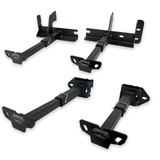
A slide-in camper resting in a pickup bed is not the same as a camper secured for travel. The bed supports the load, while the manufacturer's securing system connects the camper to the truck for the movement encountered on the road.
This guide answers why tie downs matter and what to check before a trip. For the bracket design and terminology, start with what a TorkLift camper tie down is.
Why the camper's weight is not a securing system
Braking, turns, bumps, and changing road conditions create movement between the loaded camper and the truck. A close fit in the bed does not replace the camper manufacturer's specified attachment system.
For an outboard TorkLift frame-mounted installation, the connection runs from the camper anchor through a compatible turnbuckle to the truck-mounted tie down. It should be treated as a complete system, not as a choice between brackets and turnbuckles.
Why all four connection positions matter
TorkLift describes its complete outboard system as a front pair, a rear pair, and four spring-loaded turnbuckles. A front pair alone is not a full-truck kit. Likewise, a pair of turnbuckles is not four connections.
If you are checking a shopping list, see tie downs vs turnbuckles and package quantities. If you already have hardware, record what is installed and have the manufacturer resolve missing, damaged, or uncertain components before travel.
Why more tension is not automatically better
A spring-loaded connection is designed to work according to its adjustment instructions. Do not tighten by guesswork or assume an extra turn makes the camper more secure. Use the instructions for the exact camper, tie downs, and turnbuckles.
There is no universal adjustment number in this article. Turnbuckle tension and fastener torque are different measurements. If the instructions appear inconsistent, ask TorkLift and the camper manufacturer before proceeding.
A pre-trip walk-around checklist
- Check the camper anchors and visible hardware for damage or unusual movement.
- Inspect the truck-side brackets, removable inserts, retaining pins, and clips.
- Check that all required connections and locking or retaining parts are present.
- Verify turnbuckle adjustment using the supplied instructions, not an unrelated model's settings.
- Look for road contamination, finish damage, or corrosion that needs attention.
- Follow the manufacturers' recheck instructions after installation and during travel.
This is a reminder list, not an installation inspection or approval to drive. Stop and obtain qualified help if anything is damaged, missing, or unclear. TorkLift's tie-down and FastGun maintenance guidance (opens in a new tab) explains routine care.
What tie downs cannot solve
Tie downs do not make an overloaded truck-and-camper combination acceptable. Follow the truck and camper manufacturers' loading limits and instructions. A material upgrade, extra accessory, or tighter connection is not a substitute for checking those limits.
Confirm the application before shopping
Use TorkLift's official Fit Finder (opens in a new tab) for exact front and rear bracket applications. Ask TorkLift directly (opens in a new tab) about uncertain configurations or turnbuckle requirements. BuyCamperTieDown does not provide store-side compatibility approval.
Once the manufacturer has confirmed the parts, browse camper tie downs and turnbuckles.
Manufacturer reference
TorkLift outboard system overview and vehicle-loading notice (opens in a new tab).

Why a parked camper still needs a complete securing system for travel, plus a practical pre-trip reminder checklis...

Learn how tight truck camper tie downs should be, avoid common adjustment mistakes, and keep...

Compare Torklift FastGun and traditional turnbuckles. Learn the differences in installation,...

Plan a complete tie-down purchase: compare materials, operating convenience, package quantities, and the total cos...