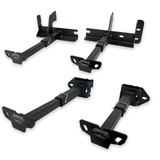
Truck camper tie downs should be tight enough to eliminate slack and keep the camper securely positioned, but not so tight that they place excessive stress on the camper’s anchor points or the truck.
For many spring-loaded systems, including popular Torklift turnbuckles, the recommended tension is approximately 300 pounds per connection. However, the correct setting depends on the specific tie-down and turnbuckle system, so always follow the manufacturer’s instructions.
Overtightening does not make a truck camper safer. In fact, too much tension can damage the camper, mounting brackets, or truck frame. The goal is controlled tension that holds the camper firmly while allowing the system to absorb normal movement during travel.
Tie Downs vs Turnbuckles: What Is Actually Being Tightened?
The terms “tie downs” and “turnbuckles” are often used interchangeably, but they are different parts of the camper mounting system.
Truck camper tie downs are the mounting points attached to the truck. Frame-mounted tie downs, such as Torklift tie downs, connect directly to the truck frame and provide secure attachment points outside the bed.
Turnbuckles connect those truck-mounted tie downs to the anchor points on the camper. The turnbuckles are the components that are adjusted to create the proper tension.
Therefore, when people ask how tight their camper tie downs should be, they are usually asking how much tension should be applied through the turnbuckles.
Why Proper Tie-Down Tension Matters
A slide-in camper is exposed to several forces while the truck is moving. Acceleration, braking, cornering, bumps, crosswinds, and uneven terrain can all cause the camper to shift.
Properly adjusted turnbuckles help:
-
Keep the camper centered in the truck bed
-
Reduce forward, backward, and side-to-side movement
-
Protect the camper’s anchor points
-
Prevent excessive stress on the truck and mounting system
-
Maintain stability during braking and cornering
-
Reduce wear caused by vibration
-
Improve safety on highways and rough roads
The system must hold the camper securely without creating a completely rigid connection. A small amount of controlled movement helps protect both the camper and the truck from sudden impact loads.
Can Truck Camper Tie Downs Be Too Tight?
Yes. Overtightening turnbuckles is one of the most common mistakes made by truck camper owners.
Applying excessive tension can:
-
Pull on or deform the camper’s anchor brackets
-
Damage the camper’s structure
-
Bend mounting hardware
-
Place unnecessary stress on the truck frame
-
Reduce the effectiveness of spring-loaded turnbuckles
-
Cause premature wear or failure of the attachment system
The camper should not be pulled downward with maximum force. Tightening a turnbuckle as far as possible does not provide additional safety.
Spring-loaded turnbuckles are specifically designed to absorb shock and maintain controlled tension. Compressing the spring beyond the manufacturer’s recommended setting can prevent the system from functioning properly.
What Happens If Tie Downs Are Too Loose?
Turnbuckles that are too loose can allow the camper to move independently of the truck.
Possible warning signs include:
-
Visible slack in a turnbuckle
-
Rattling or clunking while driving
-
The camper shifting in the truck bed
-
Uneven gaps between the camper and bed rails
-
Movement during braking or acceleration
-
Turnbuckles repeatedly becoming disconnected
-
Wear marks around camper anchor points
Even a small amount of repeated movement can loosen hardware and damage mounting points over time. A loose camper may also affect vehicle handling, especially during emergency braking or sharp turns.
How to Set the Correct Tie-Down Tension
Use the following process as a general guide. Always check the instructions supplied with your tie downs and turnbuckles before making adjustments.
1. Park on a Level Surface
Load the camper and park the truck on firm, level ground. Make sure the camper is correctly centered and positioned before attaching the turnbuckles.
Do not use turnbuckle tension to pull a badly positioned camper into place.
2. Inspect the Mounting Points
Check the truck tie downs, camper anchors, turnbuckles, pins, and fasteners for damage or corrosion.
Do not travel with:
-
Bent brackets
-
Cracked camper anchor points
-
Missing safety pins
-
Damaged threads
-
Severely rusted hardware
-
Loose frame-mounting bolts
Correct any problem before applying tension.
3. Attach All Four Turnbuckles
Connect the front and rear turnbuckles to their corresponding attachment points. Confirm that each connection is secure and that no component contacts the truck body.
Turnbuckles should follow the intended mounting angle. Do not cross them or change their orientation unless the manufacturer specifically recommends it.
4. Remove the Slack
Adjust each turnbuckle until the connection is snug and there is no visible slack.
At this stage, the turnbuckle should hold the camper securely without noticeably pulling or distorting its anchor point.
5. Apply the Recommended Preload
Adjust the spring-loaded mechanism according to its manufacturer’s instructions.
Many Torklift spring-loaded turnbuckles are designed to provide approximately 300 pounds of tension when properly adjusted. This does not mean you should use a separate tool to pull on the camper with 300 pounds of force. The turnbuckle’s internal spring and adjustment procedure are used to establish the correct preload.
Do not use a torque wrench unless the manufacturer provides a specific torque value. Thread torque and tie-down tension are not the same measurement.
6. Balance the Connections
All four connections should be secure and reasonably even. One turnbuckle should not carry most of the load while another remains loose.
Unless the manufacturer specifies otherwise, avoid making the front substantially tighter than the rear or vice versa.
7. Secure the Handles and Pins
Close quick-release handles completely and install all required locking pins, clips, or locks. Confirm that nothing can open or loosen while driving.
8. Recheck After a Short Drive
After loading the camper or making an adjustment, drive a short distance and inspect all four connections again. The camper may settle slightly during the first few miles.
Recheck the system periodically during longer trips and after traveling on rough roads.
How Tight Should Torklift FastGun Turnbuckles Be?
Torklift FastGun turnbuckles are designed to simplify tension adjustment. Once properly calibrated, their quick-release handles allow them to be removed and reinstalled without repeating the complete adjustment process every time.
A correctly adjusted FastGun should:
-
Close with firm, controlled resistance
-
Hold the camper without visible slack
-
Keep its spring-loaded mechanism within the recommended range
-
Avoid pulling or bending the camper anchor
-
Remain securely closed during travel
The handle should not be forced shut with excessive pressure. If closing it requires extreme effort, the turnbuckle may be too short or over-adjusted.
FastGuns should be adjusted individually because the required length can differ at each corner of the camper. It is helpful to keep each turnbuckle assigned to the same mounting position.
Should Front and Rear Turnbuckles Have the Same Tension?
In most installations, all four turnbuckles should be securely tensioned according to the system manufacturer’s instructions. However, equipment requirements can vary.
Some systems require spring-loaded protection at the front camper anchor points because they experience significant stress during braking and road movement. Other systems use spring-loaded turnbuckles at all four corners.
Do not assume that one universal setup is correct for every truck and camper combination. Follow the recommendations provided by both the camper manufacturer and the tie-down manufacturer.
How Often Should Tie-Down Tension Be Checked?
Inspect your truck camper tie-down system:
-
Before every trip
-
Shortly after loading the camper
-
After the first few miles of travel
-
At regular stops during long trips
-
After driving on rough or unpaved roads
-
Following hard braking or a sudden maneuver
-
After strong winds or severe weather
-
Whenever you hear unusual movement or noise
Also perform a more detailed inspection at the beginning and end of each camping season.
Threaded components should move smoothly, but lubricants should only be used where recommended. Some products require specific maintenance, and applying the wrong lubricant can attract dirt or affect locking mechanisms.
Common Tie-Down Adjustment Mistakes
Tightening Until Nothing Can Move
A camper mounting system should control movement, not create an excessively rigid connection. Spring-loaded components need room to absorb road shock.
Using Turnbuckles to Reposition the Camper
Turnbuckles are not designed to drag or center the camper in the truck bed. Position the camper correctly before applying final tension.
Ignoring Manufacturer Instructions
Tie-down systems differ in design. A setting that works for one brand or model may not be suitable for another.
Leaving One Connection Loose
All required attachment points must be used. Driving with only three properly connected turnbuckles can place uneven loads on the camper.
Mixing Incompatible Components
Avoid combining tie downs, turnbuckles, extensions, or homemade adapters unless their compatibility has been confirmed.
Failing to Recheck the System
New installations can settle, and threaded components may loosen during travel. Regular inspections are essential.
Frequently Asked Questions
Should truck camper tie downs be extremely tight?
No. They should be snug and properly preloaded, not tightened with maximum force. Excessive tension can damage the camper and mounting system.
Is hand-tightening enough?
It depends on the turnbuckle design. Traditional models may require manual adjustment, while spring-loaded and quick-release systems have specific calibration procedures. Follow the instructions for your particular model.
Why do spring-loaded turnbuckles matter?
Spring-loaded turnbuckles absorb a controlled amount of movement and reduce shock loads transferred to the camper’s anchor points.
Can loose tie downs damage a camper?
Yes. Loose connections allow repeated movement, which can wear mounting hardware, damage anchor points, and affect vehicle stability.
Can I use chains and basic hardware-store turnbuckles?
Generic hardware may not provide the required strength, spring protection, corrosion resistance, or secure locking system. Components designed and rated for truck campers are the safer choice.
Do I need to adjust FastGuns every time I reinstall them?
Once correctly calibrated and returned to the same mounting positions, FastGun turnbuckles normally retain their adjustment. They should still be inspected whenever they are installed.
Final Thoughts
Truck camper tie downs should be tight enough to remove slack and prevent the camper from shifting, but they should never be overtightened.
For many Torklift spring-loaded systems, approximately 300 pounds of tension per connection is the general target. The exact adjustment procedure must always come from the instructions for your specific turnbuckles, tie downs, and camper.
Before every trip, inspect all four attachment points, confirm that the camper is properly positioned, and make sure every handle, pin, and locking device is secure. Correct tension protects your camper, your truck, and everyone traveling with you.
Find the instructions for your confirmed model
Manufacturer videos are linked on our S9526 Original FastGun pair page. Browse camper turnbuckles for other listed models, and use the instructions supplied with your exact part for the adjustment procedure.

Why a parked camper still needs a complete securing system for travel, plus a practical pre-trip reminder checklis...

Learn how tight truck camper tie downs should be, avoid common adjustment mistakes, and keep...

Compare Torklift FastGun and traditional turnbuckles. Learn the differences in installation,...

Plan a complete tie-down purchase: compare materials, operating convenience, package quantities, and the total cos...